How7o
  • Home
  • Tools
  • Prank Screens
  • Learn
  • Blog
  • Contact
Reading: How to Check the Linux OS Name and Version from the Command Line
Share
How7oHow7o
Font ResizerAa
  • OS
Search
  • Home
  • Tools
  • Prank Screens
  • Learn
  • Blog
  • Contact
Follow US
© 2024–2026 How7o. All rights reserved.
How7o > Free Laravel, PHP, WordPress & Server Tutorials > Server Management > How to Check the Linux OS Name and Version from the Command Line
Server Management

How to Check the Linux OS Name and Version from the Command Line

how7o
By how7o
Last updated: May 22, 2026
4 Min Read
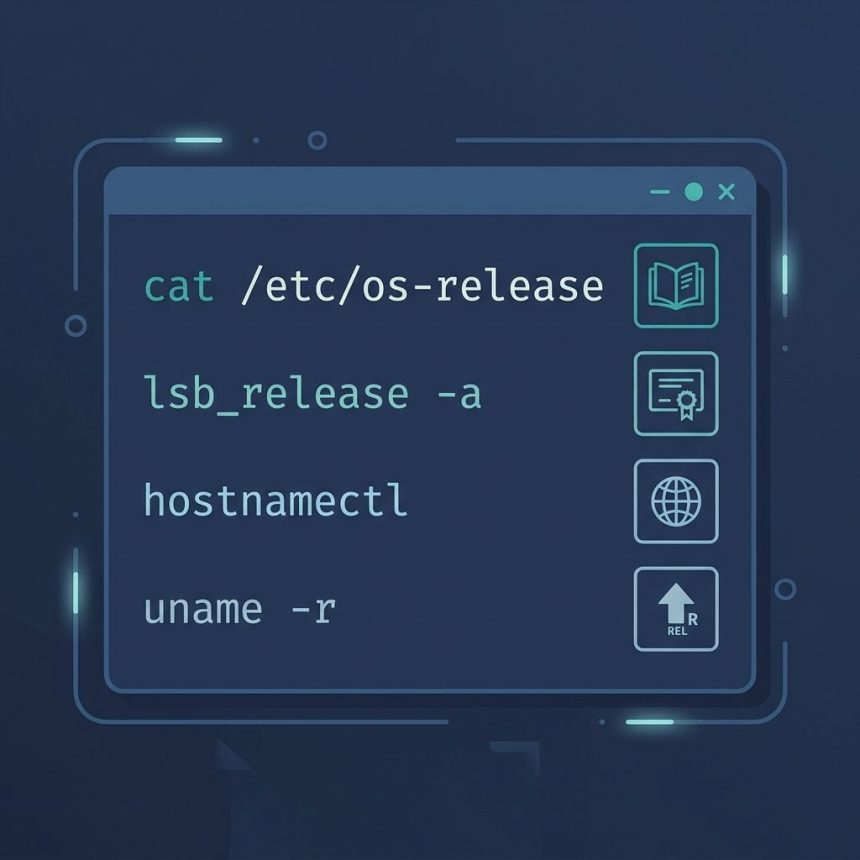
Check Linux OS name and version from the command line
SHARE

To check the Linux OS name and version from the command line, the most portable command is cat /etc/os-release — it’s a plain file present on every modern Linux. lsb_release -a and hostnamectl work too when they’re installed. For the kernel version, uname -r does the job.

Contents
  • TL;DR
  • /etc/os-release — the universal way
  • lsb_release -a — clean output, requires package
  • Kernel version with uname
  • Frequently asked questions
  • Related guides
  • References

Last verified: 2026-05-17 on AlmaLinux 9, Ubuntu 22.04, Debian 12, Fedora 40. Originally published 2022-08-18, rewritten and updated 2026-05-17.

TL;DR

# OS name + version (most portable — works on every modern Linux)
cat /etc/os-release

# Cleaner formatted output (if the lsb-release package is installed)
lsb_release -a

# System summary (OS + kernel + arch)
hostnamectl

# Kernel version only
uname -r

# Everything from uname (kernel + hostname + arch + build date)
uname -a

/etc/os-release — the universal way

cat /etc/os-release

Sample output on Ubuntu 22.04:

PRETTY_NAME="Ubuntu 22.04.4 LTS"
NAME="Ubuntu"
VERSION_ID="22.04"
VERSION="22.04.4 LTS (Jammy Jellyfish)"
VERSION_CODENAME=jammy
ID=ubuntu
ID_LIKE=debian
HOME_URL="https://www.ubuntu.com/"
SUPPORT_URL="https://help.ubuntu.com/"

The ID and VERSION_ID fields are stable, lowercase, scriptable. For shell scripts that need to branch on distro:

source /etc/os-release
case "$ID" in
  ubuntu|debian)  echo "Debian-family";;
  almalinux|rocky|rhel|centos|fedora) echo "RHEL-family";;
  *)              echo "Other: $ID";;
esac
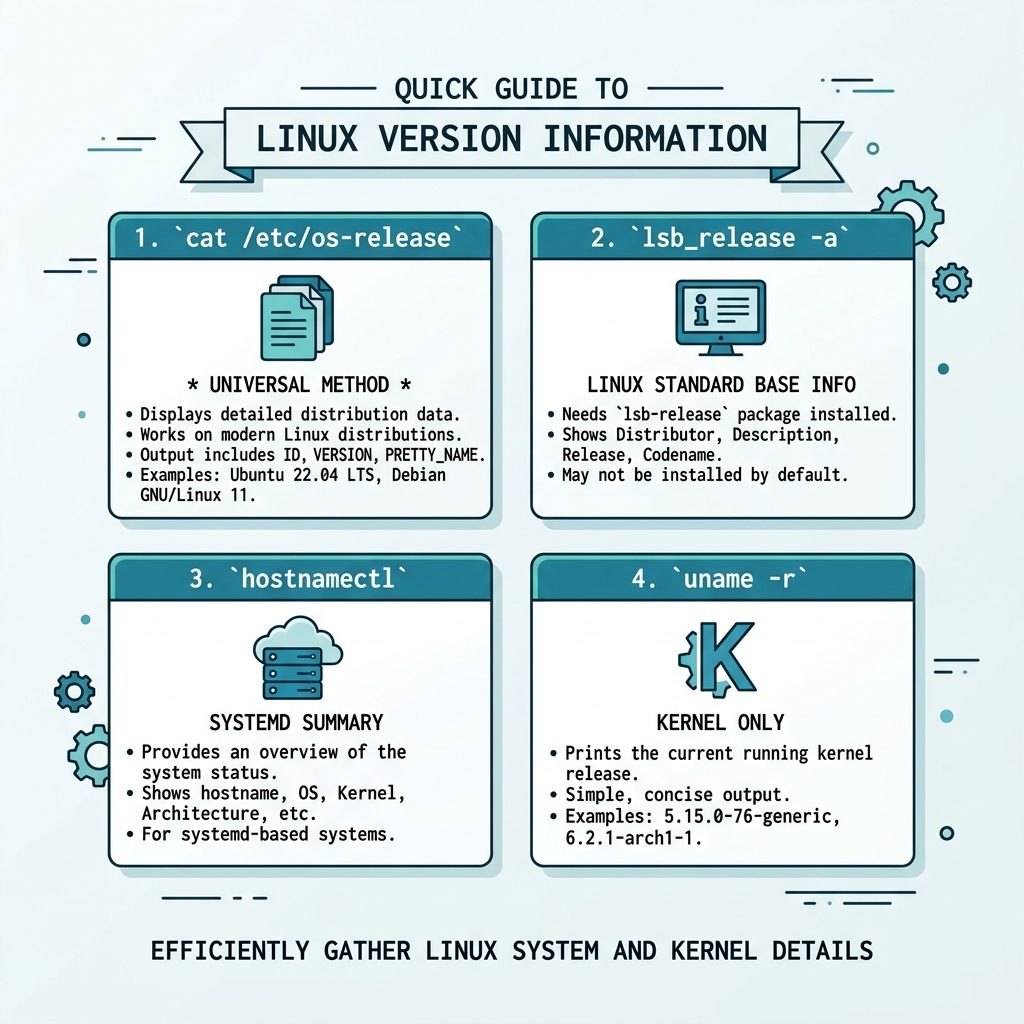
Check Linux OS version — /etc/os-release, lsb_release, hostnamectl, uname compared

lsb_release -a — clean output, requires package

lsb_release -a

Output:

Distributor ID: Ubuntu
Description:    Ubuntu 22.04.4 LTS
Release:        22.04
Codename:       jammy

If it errors with command not found, install the package (sudo apt install lsb-release on Debian/Ubuntu, sudo dnf install redhat-lsb-core on older RHEL). Newer RHEL/AlmaLinux/Rocky have moved away from lsb-release — use /etc/os-release there.

Kernel version with uname

# Just the kernel release
uname -r           # e.g. 5.15.0-105-generic

# Everything
uname -a           # kernel + hostname + arch + build date

Frequently asked questions

What’s the difference between /etc/os-release and lsb_release?

/etc/os-release is a plain file present on every modern Linux (systemd-based) — guaranteed to exist, no command needed. lsb_release is a command from the lsb-release package (sometimes not installed by default on minimal images). For a script that has to run anywhere, cat /etc/os-release is the safer choice.

Which command shows the kernel version?

uname -r for the release string (e.g. 5.15.0-105-generic), uname -a for everything (kernel, hostname, arch, build date). Note the kernel version is independent of the distro version — Ubuntu 22.04 has shipped multiple kernels over its life, all reported by uname -r.

Why does hostnamectl show ‘Operating System’ on one line and ‘Kernel’ on another?

hostnamectl consolidates information from /etc/os-release (Operating System line) and uname (Kernel line) into one tidy block. It’s a quick way to see both at once without running two commands.

Is there a single command that works on every Linux including very minimal containers?

cat /etc/os-release works on every systemd-based system, including Alpine and most slim container images. For non-systemd / pre-systemd systems (rare now), fall back to cat /etc/issue or cat /etc/*release* — one of them will have what you need.

Related guides

  • How to Check Your Ubuntu Version
  • How to List Network Devices on Linux
  • How to Add and Delete Users on a Linux Server from the Terminal

References

man os-release, man uname, man hostnamectl on any Linux. systemd os-release spec: freedesktop.org/software/systemd/man/latest/os-release.html.

TAGGED:BashconfigurationSSH

Sign Up For Daily Newsletter

Be keep up! Get the latest breaking news delivered straight to your inbox.
[mc4wp_form]
By signing up, you agree to our Terms of Use and acknowledge the data practices in our Privacy Policy. You may unsubscribe at any time.
Share This Article
Facebook Copy Link Print
Previous Article Check if an element is hidden or visible with jQuery How to Check if an Element Is Hidden or Visible with jQuery
Next Article Check Ubuntu version — terminal and Settings How to Check Your Ubuntu Version
Leave a Comment

Leave a Reply Cancel reply

You must be logged in to post a comment.

FacebookLike
XFollow
PinterestPin
InstagramFollow
Most Popular
Run Laravel queue workers with Supervisor
How to Run Laravel Queue Workers in Production with Supervisor
May 23, 2026
Nginx as a reverse proxy for a Node.js app on Ubuntu
How to Set Up Nginx as a Reverse Proxy for Node.js on Ubuntu
May 23, 2026
Install and configure Redis on Ubuntu for Laravel and WordPress
How to Install and Configure Redis on Ubuntu (for Laravel & WordPress)
May 23, 2026
Harden a fresh Ubuntu VPS with UFW, Fail2Ban, and SSH key auth
How to Harden a Fresh Ubuntu VPS: UFW + Fail2Ban + SSH Key Auth
May 23, 2026
Set up Let's Encrypt SSL with Certbot on Ubuntu
How to Set Up Let’s Encrypt SSL with Certbot on Ubuntu (Apache & Nginx)
May 23, 2026

You Might Also Like

How to temporarily disable Imunify360 service for testing (cPanel/WHM)
Server Management

How to Temporarily Disable Imunify360 Service (Safe Testing + Fix 503)

5 Min Read
Fix broken cPanel disk quotas with the fixquotas script
Server Management

How to Fix Quotas in cPanel

5 Min Read
Run a Linux cron job as a non-root user
Server Management

How to Run a Cron Job as a Non-Root User

5 Min Read
Step-by-step guide to upgrading the Linux kernel in CentOS 7 using ELRepo
Server Management

How to Upgrade the Linux Kernel in CentOS 7

9 Min Read
How7o

We provide tips, tricks, and advice for improving websites and doing better search.

Tools

  • Age Calculator
  • Word Counter
  • Image Upscaler
  • Password Generator
  • QR Code Generator
  • See all tools→

Pranks

  • Fake Blue Screen Prank
  • Hacker Typer
  • Fake iMessage Generator
  • Windows XP Crash Prank
  • Windows 11 Update Prank
  • See all prank screens →

Company

  • About Us
  • Blog
  • Contact
  • Privacy Policy
  • Terms of Service
  • Sitemap
© 2024–2026 How7o. All rights reserved.
Welcome Back!

Sign in to your account

Username or Email Address
Password

Lost your password?