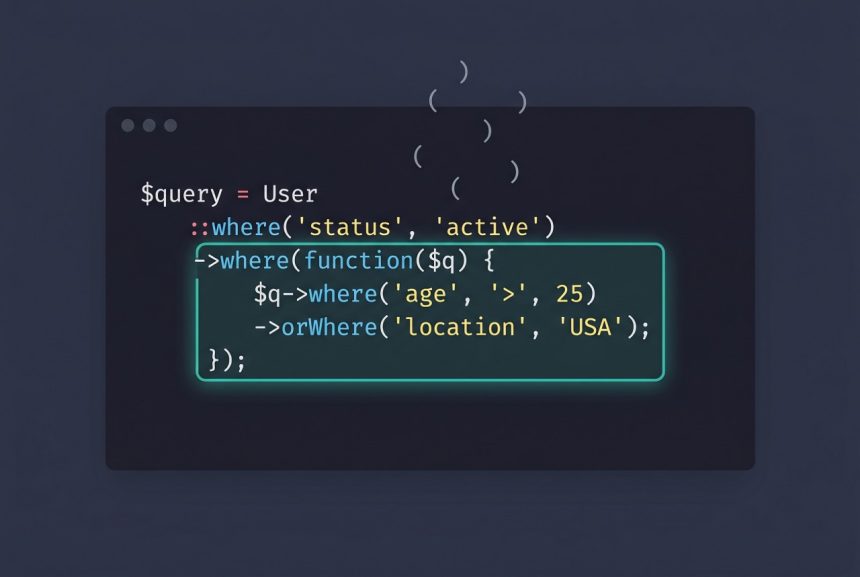
Combining laravel eloquent multiple where orwhere clauses is where a lot of search queries quietly break: the result set looks wrong because of operator precedence, and the fix is one closure away. This guide shows the exact pattern for filtering rows by two required conditions plus an OR group (for example, posts belonging to a user and written in English that match a keyword in either the title or the body), explains why wrapping the OR in a closure matters, and covers the newer whereAny / whereAll helpers added in Laravel 10.47+.
Last verified: 2026-04-21 on Laravel 11 with PHP 8.3. Originally published 2022-11-06, rewritten and updated 2026-04-21.
TL;DR
When you mix where() and orWhere(), always wrap the OR group inside a closure passed to where() — otherwise SQL operator precedence (AND binds tighter than OR) will match rows you didn’t mean to. The canonical pattern for “author X, language Y, keyword in title OR content” is a chain of where() calls with a closure for the OR group.
The canonical pattern
Here is the exact query for filtering posts by author and language, then keyword-matching against either the title or the content:
Post::where('author_id', '=', $user_id)
    ->where('language', '=', 'en')
    ->where(function($query) use ($keyword) {
        $query->where('post_title', 'LIKE', '%' . $keyword . '%');
        $query->orWhere('post_content', 'LIKE', '%' . $keyword . '%');
    })
    ->get();
Eloquent compiles that to:
SELECT * FROM posts
WHERE author_id = ?
  AND language = ?
  AND (post_title LIKE ? OR post_content LIKE ?)
The closure is what wraps the OR group in parentheses. Without it, the last two conditions would merge into the outer chain and the SQL becomes semantically different.
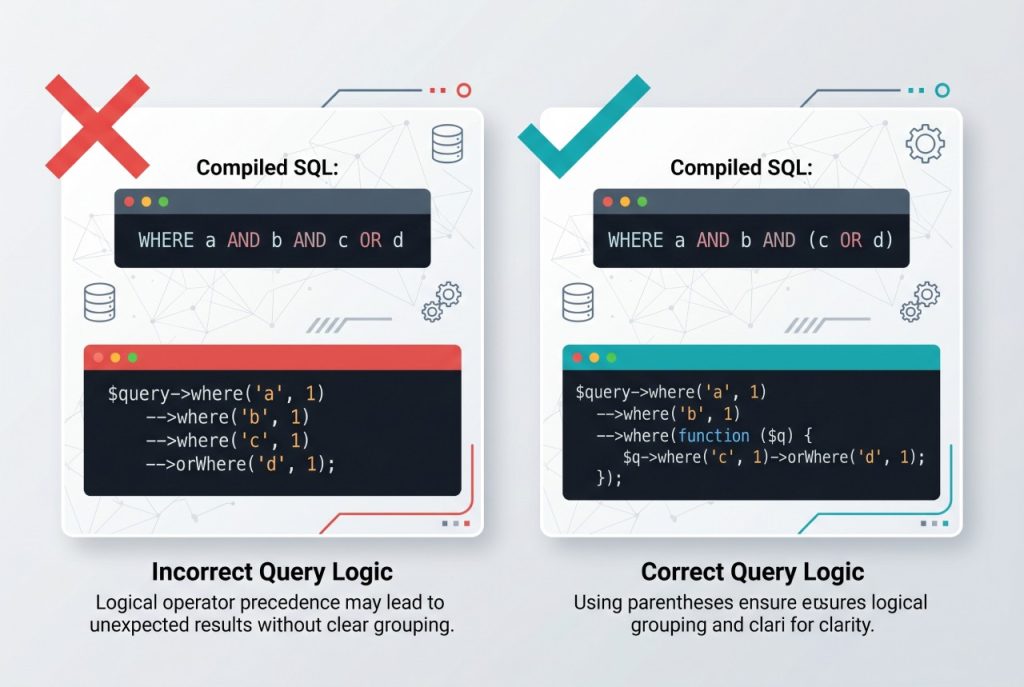
Why precedence matters — the broken version
Here is what you should not write:
// WRONG — OR collapses into the outer AND chain
Post::where('author_id', '=', $user_id)
    ->where('language', '=', 'en')
    ->where('post_title', 'LIKE', '%' . $keyword . '%')
    ->orWhere('post_content', 'LIKE', '%' . $keyword . '%')
    ->get();
That compiles to WHERE a AND b AND c OR d. SQL evaluates AND before OR, so it’s really WHERE (a AND b AND c) OR d — meaning any row where post_content matches the keyword is returned even if author_id and language don’t match. Your “posts by user X in English that mention keyword” search silently becomes “posts by user X in English matching title, plus every post in the database whose content matches”. The closure prevents that.
Nested groups and deeper logic
Closures nest. If you need (a OR b) AND (c OR d), use two closures side by side:
Post::where(function($q) {
        $q->where('status', 'published')->orWhere('status', 'featured');
    })
    ->where(function($q) use ($keyword) {
        $q->where('title', 'LIKE', "%{$keyword}%")
          ->orWhere('content', 'LIKE', "%{$keyword}%");
    })
    ->get();
Both groups get their own parentheses in the generated SQL, so precedence stays exactly where you want it.
whereAny and whereAll (Laravel 10.47+)
Laravel 10.47 added whereAny and whereAll, which reduce the closure boilerplate when you’re applying the same comparison across multiple columns. The keyword search above can be rewritten as:
Post::where('author_id', $user_id)
    ->where('language', 'en')
    ->whereAny(['post_title', 'post_content'], 'LIKE', '%' . $keyword . '%')
    ->get();
whereAny generates a closure with orWhere calls internally; whereAll does the same with where calls. Both work only when every column uses the same operator and value — for mixed conditions, fall back to the closure form.
Frequently asked questions
orWhere() without a closure return too many rows? Because SQL evaluates AND before OR. A chain like where(a)->where(b)->orWhere(c) compiles to WHERE a AND b OR c, which matches any row where c is true even if a and b are false. Wrapping the OR group in a closure produces WHERE a AND b AND (c OR d), which is what you almost always want.
orWhere conditions in Laravel? Pass a closure to where() and build the grouped conditions inside it: ->where(function($q) { $q->where('col1', 'X')->orWhere('col2', 'Y'); }). Eloquent wraps that block in parentheses in the emitted SQL, isolating its precedence from the surrounding ANDs.
where() instead of chaining? Yes. Post::where([['author_id', $user_id], ['language', 'en']])->get() is equivalent to two chained where() calls joined by AND. It’s convenient when conditions come from a config array, but it can’t express OR groups — for those, stick with closure-based grouping.
whereAny and whereAll? Added in Laravel 10.47+, they take an array of columns and a single value/operator and apply it across all of them. $query->whereAny(['title', 'content'], 'LIKE', '%' . $kw . '%') is the same as a closure with four orWhere calls — cleaner when you’re doing the same comparison across multiple columns. whereAll does the AND version.
% prevent MySQL from using the index? Yes — LIKE '%keyword%' forces a full table scan because B-tree indexes can’t short-circuit on a leading wildcard. For keyword search on large tables add a FULLTEXT index and switch to whereFullText(['title', 'content'], $kw), which emits MATCH() AGAINST() under the hood.
Related guides
- How to Install Laravel on Ubuntu — get the framework installed before running queries.
- How to Check If a Record Exists in Laravel — companion pattern for filter-driven lookups.
- Laravel Validator exists Rule — validating foreign-key filters before running the where chain.
References
Official Laravel query-builder where-clause docs: laravel.com/docs/queries. Eloquent query documentation: laravel.com/docs/eloquent.